Car Crash Driving Simulator 3D
- 4.4
- Rating
- 5.00M
- Installs
- Free
- Price
 Analysis by App-foxy
I went into Car Crash Driving Simulator 3D expecting a quick, destructive driving game, and that is exactly where its appeal begins. It is a strategy game from GamePark that turns car control into a playful test of timing, positioning, and controlled chaos. The central idea is easy to understand: drive, collide, and enjoy the visual drama of crashes without the seriousness of a traditional racing simulation.
That simplicity makes it approachable, but it also sets a clear expectation. This is not the game I would choose when I want a deep campaign, realistic motorsport rules, or a carefully structured racing career. I would choose it when I have a few spare minutes and want something immediately active, where the fun comes from seeing how a vehicle reacts when a clean drive turns into a spectacular mistake.
The game is free, carries a Teen content rating, and runs on Android devices using version 7.0 or later. Its current version is 2.9.7, and its audience is already substantial, with more than five million installs and an average rating of 4.4 from roughly seven thousand ratings. Those figures suggest that the straightforward crash-focused concept has found a broad audience, although popularity alone does not make every session equally satisfying.
You May Also Like

 Blood Strike: 2.5 Anniversary
Blood Strike’s Loadouts Turn Every Drop Into a Tactical Gamble
A close look at Blood Strike’s custom loadouts: how fast access to signature weapons reshapes its battle royale rhythm, rewards preparation, and narrows the gap between fights.

 Pandora - Music & Podcasts
Pandora’s Music Is Easy to Start, but Harder to Recover
Pandora’s strength is its low-effort path from a seed to a station. Its weak spot is how much confidence it asks you to place in connection, setup, and quiet recovery.

 8 Ball Pool
 Is Built on Rivalries, Rematches, and Routine
A close look at the rivalries, rematches, shared routines, and unanswered safety questions that turn a quick pool match into a persistent mobile community.

 Samsung Music
’s Quiet Strength Is Playing What You Already Own
Its reach comes less from spectacle than from dependable access to a personal library. That simplicity is both the app’s strongest retention engine and its ceiling.

 AccuWeather: Weather Radar
AccuWeather Review: A Quick, Clear Forecast for Everyday Decisions
For everyday plans, the best forecast is the one you can understand quickly. AccuWeather makes rain timing, radar, and local conditions easy to act on, with a few trade-offs.

 Hill Climb Racing
Why Hill Climb Racing Still Turns Crashes Into One More Run
A tiny car, a bumpy hill and one more upgrade: Hill Climb Racing keeps resurfacing because its simple chaos makes every near-miss feel personal.
More From Our News Desk



How the first drive sets expectations
The first impression is built around movement rather than explanation. I do not need a long introduction to understand what the game wants from me. I get behind the wheel, start driving, and quickly learn that the pleasure is in making contact, recovering from awkward angles, and creating a crash that feels more entertaining than a normal clean lap.
That directness works especially well on a phone. Touchscreen games can lose momentum when they bury the player under menus or instructions, but this one benefits from getting to the action quickly. I can pick it up during a short break, make a few attempts, and put it down without feeling that I have abandoned a complicated project.
The trade-off is that the opening does not create a strong personal attachment to a driver, team, or long-term story. I am not playing to discover a character or follow a dramatic racing season. I am playing for the immediate physical joke of a car losing control, meeting an obstacle, or turning a bad approach into a memorable collision.
That distinction matters when deciding whether to install it. If you enjoy arcade driving where the result is measured by spectacle and experimentation, the opening is inviting. If you prefer a game to teach a large system gradually and reward careful progression over repeated physical experiments, the first few sessions may feel lightweight.
A useful way to approach the early sessions
I found it more enjoyable to treat the first attempts as observation rather than competition. Instead of trying to drive perfectly, I watched how much speed I could carry into a turn, how early I needed to correct the vehicle, and which approach produced the most satisfying impact. This mindset makes failure useful because a crash is not automatically wasted time; it can show me what the driving model allows.
A practical everyday scenario is a short commute or lunch break. I can play for a handful of minutes without needing to remember a complicated objective. One session might be about finding a safer route through a space, while the next becomes an experiment in deliberately creating a more dramatic collision. That small change of intention keeps the basic loop from feeling completely flat.
My advice is to avoid judging the game after one careless crash. The controls become more readable when I stop fighting the vehicle and start anticipating its momentum. I get better results by making smaller steering changes before a collision rather than waiting until the car is already in trouble.
The visual language of controlled destruction
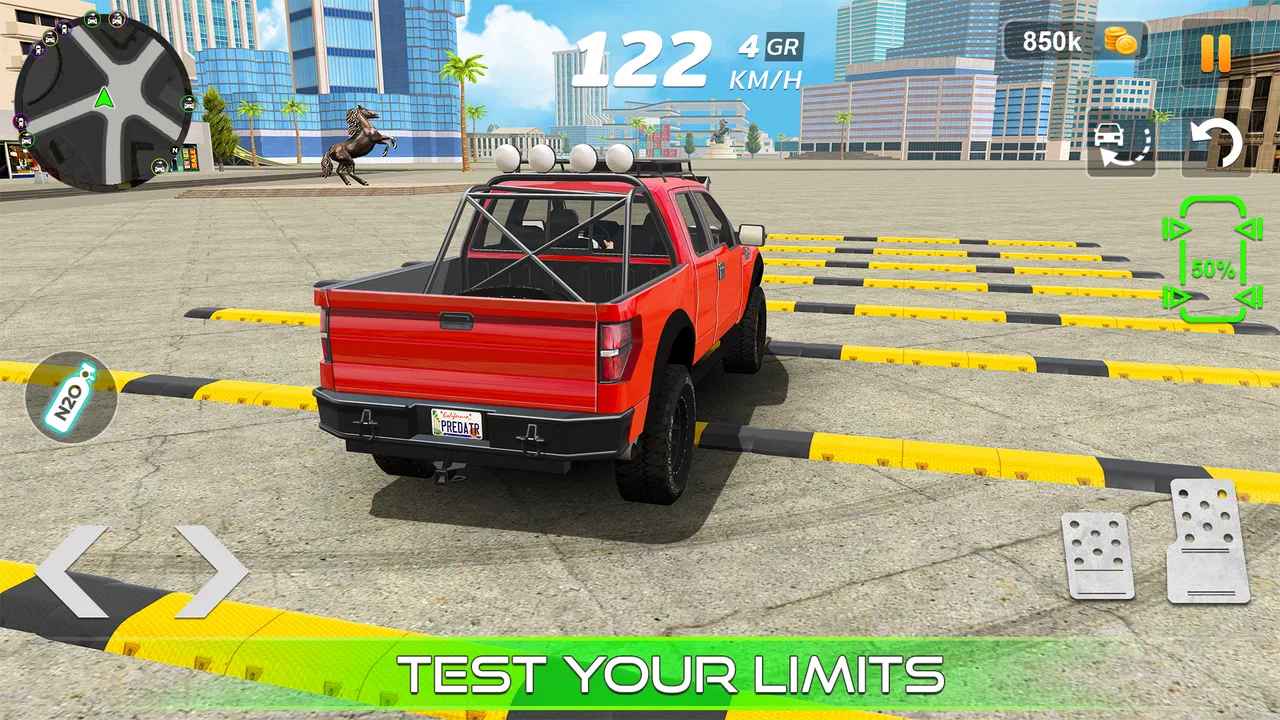
The art direction supports the game’s central mood by making the car and its movement the main visual subject. The setting is not presented as a realistic world that demands detailed attention to traffic laws, scenery, or everyday driving. Instead, it functions as a stage for speed, impact, and recovery. That keeps my eyes focused on the route ahead and on the moment when the vehicle begins to slide away from my intended line.
This choice gives the game a coherent identity. A more realistic presentation would create expectations about accurate handling, believable road behavior, and serious consequences. Here, the visual language tells me to accept exaggeration. The car is a toy-like instrument for testing momentum, and the environment is valuable because it gives that instrument something to react against.
I also like how the presentation leaves room for the player’s imagination. A simple drive can become a small story: I approached too quickly, clipped something, spun around, and tried to recover before the next impact. The game does not need a narrator to explain that sequence. The movement itself supplies the drama.
At the same time, a crash-centered design can become visually repetitive if I expect constant novelty. The strongest moments come from changing my approach, not from assuming that every attempt will offer a completely new scene. I get more out of the art direction when I use different speeds, angles, and routes to create variation within the same basic spaces.
Why the setting works better as a playground than a destination
I would describe the setting as a playground for vehicle behavior rather than a world I want to explore for its own sake. That is not a criticism by itself. It means the environment has a clear job: frame the action, provide surfaces and obstacles, and make the car’s movement readable.
This also explains why the game may suit players who like sandbox-style experiments more than players who need a strong sense of place. I can spend time testing what happens when I approach a situation from a different direction, but I am not expecting the atmosphere of a large open-world driving title. A conventional racing game may be the better choice if the pleasure for me comes from learning a detailed circuit and improving a precise lap.
The useful trade-off is focus. Because the setting does not compete heavily with the crash itself, I can concentrate on the relationship between speed and control. That makes it easier to notice a common mistake: steering too late, then blaming the collision on the vehicle rather than on the approach. Once I begin reading the space as a sequence of decisions, the visual simplicity becomes an advantage.
Sound, pacing, and the mood of a crash
The sound design matters because a crash game needs impact to feel like an event. Even when the visual action is simple, the sense of contact, interruption, and sudden loss of control gives each mistake its emotional punctuation. I do not need a complicated musical score to understand the rhythm. The game’s mood comes from the contrast between a short period of driving and the abrupt disruption caused by an impact.
That rhythm is one of the reasons the game works in short sessions. A clean approach creates anticipation, the collision creates a sharp payoff, and the reset or recovery lets me try again. It is a compact loop, but it has a recognizable beat. I can play casually without preparing for a long race, and I can also become more deliberate by trying to make each attempt cleaner or more dramatic.
The pacing is best when I allow the game to alternate between control and disorder. If I rush every approach, the experience turns into a sequence of similar accidents. If I spend too long driving cautiously, I lose the playful energy that makes this title different from a standard simulator. The sweet spot is to build enough speed to create tension while keeping enough control to make the result feel earned.
The most enjoyable rhythm comes from turning mistakes into experiments. I might deliberately change my entry angle, brake earlier, or use a wider line simply to see whether the next crash develops differently. That small habit gives the audio-visual impact more meaning because I am not just waiting for random destruction; I am setting up a test and reading the outcome.
When the atmosphere loses some force
The same short-loop structure can also expose the game’s main limitation. If I want a soundtrack-led experience, a dramatic career, or a strong sense of escalation, the crash-and-retry rhythm may not provide enough variety by itself. The atmosphere is coherent, but coherence is not the same as endless freshness.
I would therefore recommend playing in focused bursts rather than forcing a long uninterrupted session. After several similar attempts, I am more likely to notice repetition and less likely to appreciate the physical humor. Putting the game down and returning later helps preserve the surprise of the next collision.
This is where it differs from more traditional racing alternatives. A racing game can maintain interest through lap improvement, vehicle tuning, opponents, or a calendar of events. This title creates interest through immediate physical interaction. Neither approach is automatically better, but they satisfy different moods. I reach for this one when I want impact now, not when I want a season-long objective.
How the driving mechanics support the theme
Although the game is categorized as strategy, I experience its strategy in a very practical way. The decisions are made through driving: where to position the car, how much speed to carry, when to correct, and whether to pursue a clean passage or a more spectacular crash. The strategic layer is not about managing a large organization; it is about choosing an approach and accepting its consequences.
That makes the title more thoughtful than its destructive premise might suggest. A random collision can be funny once, but the lasting appeal comes from understanding why it happened. I learn to separate three problems: entering too fast, turning too late, and recovering too aggressively. Each requires a different adjustment, which gives repeated attempts a small but satisfying learning curve.
One of my favorite practical techniques is to make only one change per attempt. If I alter speed, steering, and route at the same time, I cannot tell what improved the result. If I slow down but keep the same line, I can see whether momentum was the problem. If that works, I can then test a different angle. This turns casual play into a simple driving laboratory.
Another useful approach is to decide before each run whether the goal is control or spectacle. For control, I use a conservative line and focus on recovery. For spectacle, I accept a greater risk and aim for a collision that creates a more dramatic sequence. Mixing those goals without thinking can make the game feel inconsistent, while choosing one gives each attempt a clearer purpose.
What the game does well for mobile play
The strongest mechanical fit is its accessibility. I do not need a controller or a large screen to understand the basic appeal. The game’s short, physical interactions are suited to touch play, and the free entry point makes it easy to try without treating the download as a major commitment.
It is also a good option for players who enjoy watching systems react. The satisfaction does not come only from winning. It comes from seeing a small input produce a large change in the car’s movement. That makes it appealing to people who like trial and error, especially those who enjoy games where failure reveals the boundaries of the mechanics.
However, players seeking realistic driving should be cautious. The title’s purpose is entertainment through crashes, so I would not use it to practice real-world road behavior or to replace a serious driving simulation. The Teen rating also makes it more appropriate for older players than for young children, particularly because the entire premise centers on vehicle collisions.
Where another driving game may be the better fit
I would choose a conventional racing game when I want opponents, clean laps, or a clear sense of progression. I would choose a realistic simulator when I want careful braking, authentic road etiquette, and the discipline of maintaining control. I would choose an open-world driving game when exploration matters as much as the vehicle itself.
I would choose this game instead when I want a compact, crash-focused experience that does not demand a long commitment. Its value is concentrated in the moment-to-moment interaction. It is less about building a perfect driver and more about discovering how much drama can come from a small space, a moving car, and one poorly judged decision.
The developer, GamePark, has positioned the experience around that focused idea rather than trying to make it serve every driving audience at once. In my view, that focus is a strength, provided I approach it with the right expectations. The game is not pretending to be a complete motorsport package; its identity comes from turning driving errors into entertainment.
Who should install it and who should skip it
I would recommend it to anyone who likes car crash games, quick arcade sessions, and physics-driven trial and error. It is particularly suitable for players who enjoy experimenting with angles and momentum instead of following one prescribed route. It can also work for someone who wants a low-pressure game to open between other tasks, because the basic objective is understandable almost immediately.
It is less suitable for players who need a strong narrative, a detailed career, or a constant stream of new competitive goals. If I become frustrated by repeating a small set of driving ideas, the game may not hold my attention for long. The same is true if I want a polished racing structure where every clean corner contributes to a larger championship objective.
Before installing, I would also consider the device requirement and audience rating. The game supports Android from version 7.0 onward, which makes it accessible to many older devices, but the actual comfort of play will still depend on the phone’s screen and performance. I would keep expectations realistic: broad compatibility does not automatically mean every handset will feel equally smooth or responsive.
The current version, 2.9.7, is the one I would use when evaluating the experience today. That detail is useful because mobile games can change over time, and control feel or presentation may be adjusted through updates. I would not assume that an older video or review reflects the exact behavior I encounter now.
Small habits that make the experience better
I get more enjoyment by lowering the pressure to succeed. Instead of treating every crash as a failure, I ask what it taught me about the car’s momentum. I also avoid making a long session out of a loop that is designed for quick repetition. A short break after a few attempts keeps the sound and visual impact from becoming background noise.
It helps to play with a clear purpose. One session can focus on minimizing contact, another on finding the most reliable way to recover, and another on creating a memorable collision. These self-made objectives add structure without pretending that the game has the same progression model as a full racing campaign.
Finally, I would not compare every moment with realistic driving software. That comparison misses the point. The better question is whether the controls, setting, sound, and pacing work together to make vehicle destruction entertaining. When I judge it on those terms, the game becomes easier to appreciate.
My atmosphere verdict
Car Crash Driving Simulator 3D succeeds because its art direction, sound, setting, and pacing all point toward the same mood: playful danger. The visual world frames the car as a toy for experimentation, the sound gives collisions their punctuation, and the short rhythm makes it easy to try again after a mistake. The mechanics remain simple, but they are not empty; they reward attention to speed, position, and timing.
My honest reservation is that this focused idea can lose energy if I expect the depth or variety of a full racing game. The title is strongest when I want immediate action and accept that repetition is part of the design. It is not the right choice for serious simulation, narrative progression, or long competitive sessions.
For the right player, though, the free price and direct structure make it easy to recommend. I can install it for a quick burst, learn from a bad approach, and return later for another round of controlled chaos. Its best quality is not simply that cars crash; it is that each crash gives me a reason to rethink the next drive.
With its Teen rating, broad Android compatibility, and established audience, it is a sensible pick for older mobile players who want a light strategy-driven driving game rather than a demanding racing career. I would recommend it to a friend who enjoys experimenting, laughing at spectacular mistakes, and playing in short bursts. I would steer a friend toward another title if they wanted realism, exploration, or a deep progression system. In its own lane, however, GamePark’s crash-focused game creates a clear and consistent playable mood.
FAQs for Car Crash Driving Simulator 3D
01What is Car Crash Driving Simulator 3D about?
Car Crash Driving Simulator 3D is a game designed for players who enjoy realistic car crash physics and thrilling driving adventures. It allows you to experience high-speed crashes, perform stunts, and explore various terrains. The game features multiple vehicles and environments, providing a dynamic and immersive gameplay experience.
02Is Car Crash Driving Simulator 3D free to play?
Yes, Car Crash Driving Simulator 3D is free to download and play on both Android and iOS platforms. However, the game may offer in-app purchases for additional features, vehicles, or customization options. These purchases are optional and designed to enhance the gaming experience without being necessary for core gameplay.
03What features make Car Crash Driving Simulator 3D stand out?
Car Crash Driving Simulator 3D offers realistic car physics, detailed crash mechanics, and a wide variety of cars and environments. The game also includes customizable settings and challenges that test your driving skills. Its realistic graphics and sound effects contribute to an immersive experience, making it popular among car simulation enthusiasts.
04Are there any age restrictions for playing Car Crash Driving Simulator 3D?
Car Crash Driving Simulator 3D is generally suitable for players aged 12 and up. The game features realistic crash scenarios, which might not be appropriate for younger audiences. Parents should review the game’s content and settings to ensure they are comfortable with the level of simulated violence depicted.
05Can I play Car Crash Driving Simulator 3D offline?
Yes, Car Crash Driving Simulator 3D can be played offline, allowing you to enjoy the game without a constant internet connection. However, some features, such as in-app purchases or online leaderboards, may require an internet connection to function. Always check your device settings to ensure optimal performance.
Pros
- Realistic crash physics create immersive gameplay.
- Wide range of vehicles to choose from and test.
- Detailed environments enhance visual appeal.
- User-friendly controls for easy navigation.
- Regular updates with new features and cars.
Cons
- Occasional bugs can disrupt the experience.
- Graphics may lag on older devices.
- In-app purchases can be expensive.
- Limited customization options for vehicles.
- Ads can be intrusive during gameplay.

Car Crash Driving Simulator 3D
Gallery